

JAKARTA, TEROPONGMEDIA.ID – Indonesia’s PKPU mechanism (Penundaan Kewajiban Pembayaran Utang, or Suspension of Debt Payment Obligations) is meant to give struggling companies a second chance. A debtor proposes a restructuring plan, creditors vote, and if the court ratifies the deal, everyone moves forward under new terms. On paper, it is a sensible framework. In practice, it has become one of the most significant risks facing anyone who extends credit to an Indonesian company.
The case of PT Net Satu Indonesia, formerly PT Sampoerna Telekomunikasi Indonesia, commercially known as Net1 Indonesia, illustrates why. When this company went through PKPU in 2022, creditors across the board were left holding near-worthless claims: the Indonesian government lost hundreds of billions of rupiah in unpaid spectrum fees, domestic vendors were wiped out, and foreign suppliers saw receivables worth millions of dollars reduced to pennies on the dollar. Then the company vanished under the veneer of legality.
What Happened to Net1 Indonesia
Net1 Indonesia operated as the country’s sole telecommunications provider on the 450 MHz frequency band, using 4G LTE technology to serve rural and underserved areas across the archipelago. The company held a national license and had positioned itself as the answer to Indonesia’s digital divide, offering broadband connectivity where no other operator was willing to go.
The ambition outpaced the execution. By 2019, Net1 had stopped paying its spectrum usage fees to the government. Disputes with suppliers were mounting. On 30 November 2021, the Ministry of Communication and Information Technology revoked Net1’s operating license after the company failed to settle approximately IDR 477 billion (around USD 33 million) in overdue frequency fees for 2019 and 2020. The revocation was immediate. Roughly 23,000 subscribers lost service overnight.
With no license and no revenue, the company was effectively dead. What remained was a mountain of debt—owed to the state, to domestic partners, and to foreign suppliers who had shipped millions of dollars’ worth of equipment on credit.
Weeks after the license revocation, a PKPU petition was filed.
How the PKPU Played Out
The PKPU proceeding against PT Net Satu Indonesia was initiated in January 2022 at the Commercial Court in Jakarta. From the outset, the process raised questions. The petitioning creditor appeared to have existing business ties with Net1—a pattern that seasoned observers of Indonesian insolvency proceedings will recognize. When the party filing for your restructuring is someone you do business with, the line between adversarial creditor and cooperative partner becomes difficult to draw.
The composition plan that emerged was, by any measure, extraordinary in its generosity to the debtor:
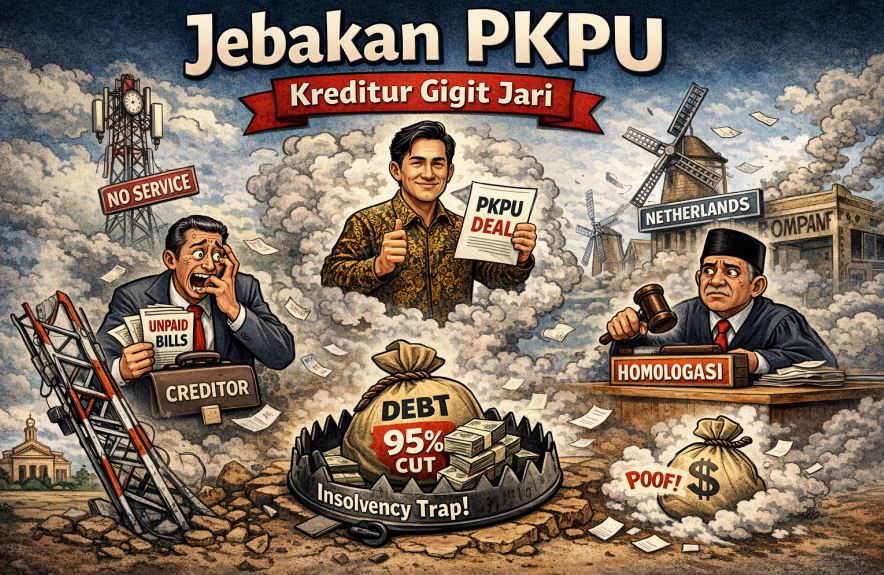
Trade creditors—unsecured suppliers both domestic and foreign—faced a haircut of 90 to 95 percent. For some foreign suppliers, this translated to losses exceeding USD 1.5 million on a single transaction.
The remaining balance was subject to a cash waterfall mechanism that prioritized taxes, operational costs, and financing from prospective new creditors. Unsecured trade creditors sat at the very bottom.
The debtor’s own projections placed best-case repayment at three years out, with a realistic timeline of ten to fifteen years.
No security or guarantees backed the plan. Clauses within the proposal appeared to allow the debtor to default on its obligations without meaningful consequence.
The creditors voted to accept. The court ratified the plan through homologation. Under Indonesian law, a homologated composition plan is binding and essentially immune to appeal.
And Then There Was None
After the PKPU plan was ratified, Net1 Indonesia ceased to function as an operating entity. Its offices became unreachable. Its phone numbers went dead. No commercial activity could be detected. The company that had signed contracts with government agencies, built a national wireless network, and imported equipment from suppliers across Asia simply stopped existing in any meaningful sense.
A review of the company’s corporate records reveals that Net1 Indonesia’s shareholders included Netherlands-based holding entities registered at addresses in Amsterdam and Gouda. Inquiries to these addresses have indicated no staff or operational presence. It seems that even the foreign holding layer of the corporate structure consists of shell entities with no substantive operations.
The creditors—domestic and foreign alike—were left holding restructured claims against a shell. The Indonesian government, owed hundreds of billions of rupiah in spectrum fees, appears no closer to recovering its money than any private supplier. The PKPU plan that was supposed to provide a structured path to partial recovery now looks less like a restructuring and more like a managed disappearance.
The Systemic Problem
Net1’s case is striking, but the underlying dynamics are not unique. Indonesia’s PKPU framework has several structural features that, in the wrong hands, can be turned against creditors.
The barriers to filing are low. There are no minimum debt threshold and no insolvency test. A PKPU petition can be initiated by any creditor—or by the debtor itself—as long as the debtor has at least two creditors and one overdue obligation. This has led to a well-documented trend of strategic filings, where the petition serves the debtor’s interests rather than the creditors.
The voting mechanics can be gamed. A composition plan passes if it receives consent from more than half the unsecured creditors present, representing at least two-thirds of acknowledged debt. In cases where some creditors have ties to the debtor, or where affiliated entities hold claims, the arithmetic can be arranged.
And once a plan is homologated, recourse is minimal. The court can refuse ratification if it finds fraud or collusion, but this safeguard is rarely invoked. Foreign creditors, often less familiar with the proceedings and facing language and jurisdictional barriers, are at a particular disadvantage.
The result is a regime where a debtor can, in effect, use the insolvency process to slash its liabilities by 90 percent or more, lock creditors into repayment schedules stretching over a decade, provide no guarantees—and then simply stop operating. Legally, nothing improper has occurred. Commercially, the creditors have been wiped out.
What’s Left
Net1 Indonesia’s creditors—from the Indonesian treasury down to individual equipment suppliers—are left with the same thing: legally restructured claims against a company that no longer answers its phone. Some of these creditors had won court cases validating their claims before the PKPU intervened. Some had supplied goods in good faith to what appeared to be a licensed, operational telecommunications company. None of that mattered once the composition plan was ratified.
Indonesia is a market of enormous potential, and many foreign companies operate there successfully. But for anyone extending unsecured credit to an Indonesian counterpart, the Net1 story is worth knowing. The legal system may validate your claim. It may also, through an entirely separate mechanism, render it worthless.